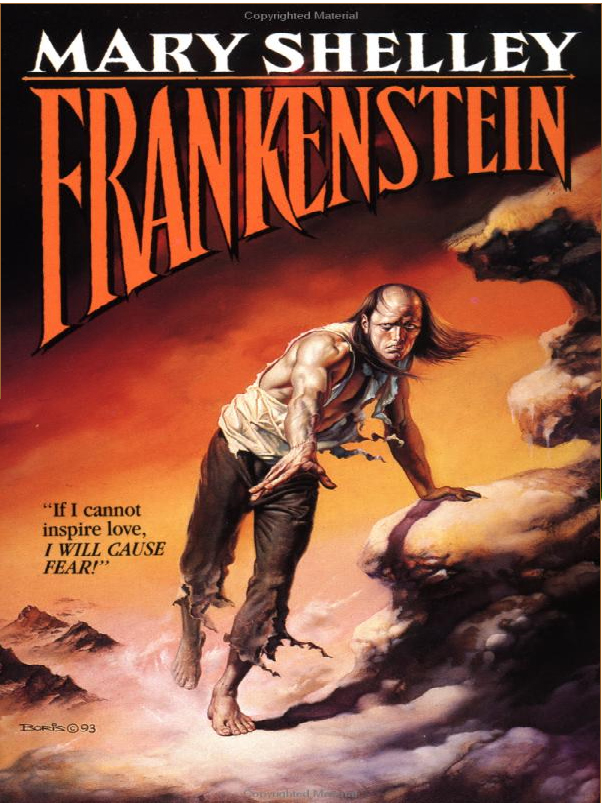
 I bought Frankenstein on a whim sometime this past year...I figured it was a classic and since I've read (and like) Dracula, I should probably give Frankenstein a shot too, right? :) So I brought it with me on my trip to Denver and finished it up last night.
I have to admit that it was different from what I expected. Having seen pieces of old movies and Mel Brook's Young Frankenstein (clearly not a literal interpretation of Mary Shelly's book), I've always felt very sympathetic for poor ol' Frankenstein. He's this giant, disproportionate creation who was abandoned by his creator and was too hideous for anyone to love, right?
I remember mom telling me about a scene in an old Frankenstein movie (that I haven't seen) where the monster accidentally kills a small child because he doesn't know his own strength. In the book, the innocence of that situation is not the case...at all.
But a little background before I jump into Frankenstein and his monster.
Mary Shelley was 18 years old when she began writing Frankenstein, the result of a competition between herself, her future husband (Percy Bysshe Shelley) and Lord Byron. They were stuck indoors due to poor weather and decided to each attempt to write a ghost/horror story...thus Frankenstein was born. It was published two years later in 1818.
I was very impressed by the writing of the 18-20 year old Mary Shelley...originally intended to be a short story, it turned into a full fledged novel with relative ease. Granted, some parts drag a bit due to the style of overly prolific and flowery narrative, but it feels more due to enthusiasm as opposed to padding to extend the story.
The beginning of Frankenstein (listed as a preface in an online edition I found) is a series of letters from a man (Robert Walton) to his sister (Margaret) about his journeys, endeavors (which include working on a whaler) and finally about some great venture he is trying to accomplish, leading up to finding Victor Frankenstein stranded on the ice-covered ocean while in pursuit of his monster. Victor is near death from exposure and despair, but recovers long enough to tell his miserable tale before expiring (at the end of the book). The tale which unfolds is different than I'd anticipated...
Victor Frankenstein paints a picture of his childhood, which boasted of two loving & wealthy parents, two younger brothers (Ernest and William) and an adopted sister (Elizabeth), who was his best friend and future wife. From a young age, Victor was fascinated by the natural sciences and became obsessed at the university with unlocking the mysteries of science, eventually developed "a secret technique to imbue inanimate bodies with life." The details of reanimation are quite vague and you are suddenly introduced to Frankenstein's monster when Victor illustrates him thusly:
"How can I describe my emotions at this catastrophe, or how delineate the wretch whom with such infinite pains and care I had endeavoured to form? His limbs were in proportion, and I had selected his features as beautiful. Beautiful!--Great God! His yellow skin scarcely covered the work of muscles and arteries beneath; his hair was of a lustrous black, and flowing; his teeth of a pearly whiteness; but these luxuriances only formed a more horrid contrast with his watery eyes, that seemed almost of the same colour as the dun white sockets in which they were set, his shrivelled complexion and straight black lips."
Disgusted by his creation, Victor flees the room, leaving the poor wretch alone and rejected. The monster eventually follows Victor to his bedroom, only to be met with loathing as Victor "escaped, and rushed down stairs." You then hear nothing of the monster for months, during which time Victor has a complete physical and mental breakdown. His dear friend, Henry Cheval, nurses Victor back to health and takes him home to Geneva, only to find his brother William has been murdered and the nanny, Justine, accused of the heinous crime. Victor is sure the monster was to blame, but has no wait to prove it...resulting in Justine being hung for William's murder.
Racked by guilt for unleashing this evil upon the world, Victor wanders in the mountains and eventually comes across the monster, who admits to killing William (out of rage once he found out that William was related to Victor, who he hates for abandoning him) and then framing Justine. The monster forces Victor to listen to a narrative of his trials and tribulations, ultimately asking Victor to make him a female companion, as ugly and deformed as himself, since there was no other way for him to find love or companionship. He claims that the lack of love and acceptance is what has caused his dark nature and that if Victor creates him a companion, they will vanish into the wilderness, never again to wreak death and destruction upon mankind.
Initially Victor consents, convincing himself even the monster should have companionship and that it's the best way to protect the remaining members of his family. As he nears completion of his abhorrent task, he has a change of heart and unequivocally refused to beget another daemon,* which could theoretically have a worse disposition than his first atrocity. What havoc they could reap together! Needless to say, the monster was furious and three more deaths lay in the wake of his rage. He then taunts Victor into pursuing him across the globe, until we end up full circle, back upon the ship that rescued Victor on his quest to destroy his creation.
The story concludes with the monster appearing after Victor finally passes away on the ship, lamenting the death of the only person to whom he has a claim for care and attention. He feels guilt for his actions, though justifies them by the injustice of his existence. He tells Robert Walton:
" You, who call Frankenstein your friend, seem to have a knowledge of my crimes and his misfortunes. But in the detail which he gave you of them he could not sum up the hours and months of misery which I endured, wasting in impotent passions. For while I destroyed his hopes, I did not satisfy my own desires. They were for ever ardent and craving; still I desired love and fellowship, and I was still spurned. Was there no injustice in this? Am I to be thought the only criminal when all human kind sinned against me?"
The monster then flees the ship, never to be heard from again.
The end.
~ Katie
*In the book he frequently refers to the monster as a daemon (-n): a demigod, a demon, a fiend.


Thanks for this review- I had no idea the detail and depth in the book having only seen the movie- so many years ago. We'll have to watch it together- I'd like your assessment as to how much the screen writer included from the book. I too am amazed the author was so young! I'd like to know more about her life after age 20!
ReplyDeleteHer life post-Frankenstein was a mixed bag. She published a fair number of other things, nothing as popular or well known as Frankenstein. And as for her marrying Percy Shelley...weeeell, it was after having been his mistress for two years and came about after his wife committed suicide in 1816...so she wasn't the most respectable young lady ever. I do feel badly for her because she lost 3 children (one as a toddler to malaria, I think...and had two miscarriages?)...she did have one son whom she lived and traveled with after the death of her husband in 1822.
Delete